What Is It?
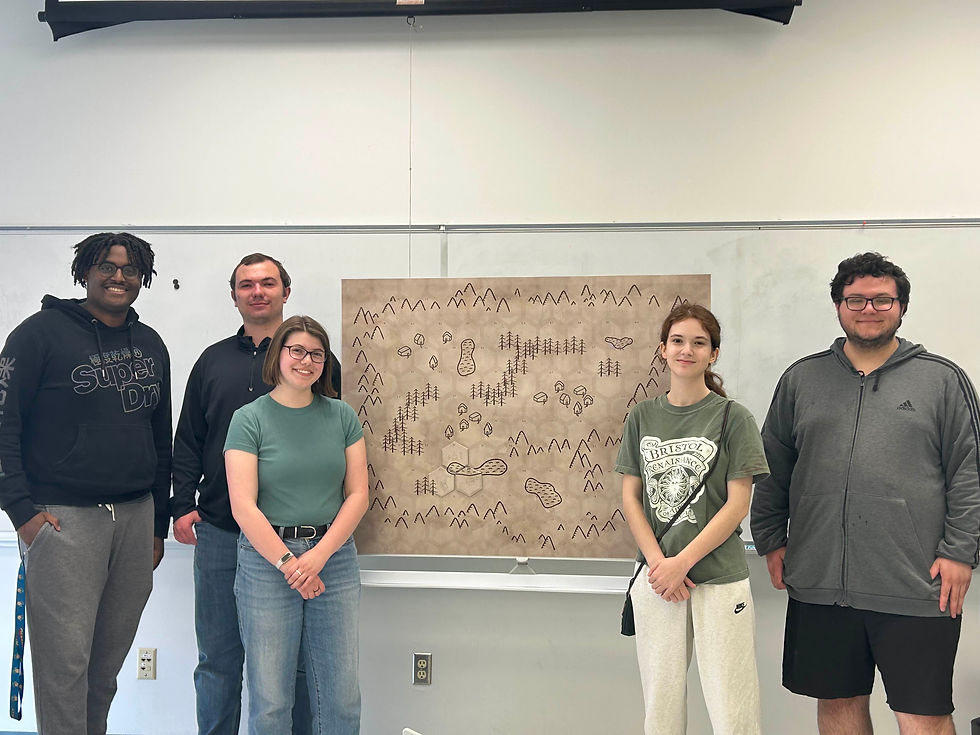
Lay of the Land is a community world-building experience where players do a short improv scene, and any world lore they establish will become part of our story, and landmarks created will be added to our map. We created a map, prompt cards, magnetic tiles, and improv guides to teach improv to the Peoria community at FUSE and build a shared world together.
Lay of the Land is a catapult project for Bradley University's FUSE showcase. Of the 16 projects pitched, it was one of the 8 that were chosen to go into production.
What Is My Role?
I was chosen by my professors to lead a FUSE catapult team. Our department of 300+ students is split into 16 teams and given a few weeks to pitch an exhibit for FUSE. As team lead, I act both as the lead game designer and a producer.
My responsibilities include:
-
Roadmapping
-
Running weekly stand-ups
-
Checking in with all disciplines
-
Communicating with Professors
-
Creating new iterations
-
Building magnet tiles
-
Maintaining a version history log
-
Playtesting
-
Giving feedback
-
Teaching the game
-
Taking the game to conventions
As president of Bradley University's Improv Troupe, creating a game that allowed me to lower the barrier to entry of improv to people was very important to me. While this project only took 5 people to make, we reached out to the improv troupe to help us run the game at FUSE, bringing our 5-person team to a 10-person team.
Since FUSE, we've been asked to show our game at the Peoria Street festival. I'm excited to teach improv to more of the Peoria Community.
Development
Lay of the Land went through 11 gameplay iterations before we landed on the final rules.
Originally, we had a map and gave players a starting location card and a relationship card. The host would give them a goal.
This system allowed players to jump to any location on the map and led to awkward moments of not knowing what to do while "traveling" between locations. Since this system gave players a starting location, they had a tendency to create objects instead of fleshing out the surrounding area.
Our system of putting their landmarks on clear sticky notes wasn't very elegant. Without a clear order of events, the game master would be tasked with remembering all scenes and recapping the story thus far to the players.


The final version of Lay of the Land used a map on a white board, a system of magnetic hexagon tiles overtop of it, and prompt cards.
To not overwhelm the players, the game master would add a new tile to the board and get rid of the 3rd oldest one at the start of every game. With only 2 other locations to keep in mind, players were able to build off the landmarks around them.
This system had 1 player draw a relationship and mood, and another draw an object and a goal. They'd choose the 1 they had more ideas for, and the combination of cards would become their prompt. This allowed people a specific and more vague goal, thereby allowing seasoned roleplayers and newcomers to start with something they were comfortable with.
As an analog project in a nontraditional medium, we ran into problems we couldn't have predicted. From how many tiles to fit on the board, to storing the tiles and ensuring they didn't weigh enough to break the whiteboard shelf, we learned how to adapt and look for physical bugs in the game.
I kept a detailing every decision made in the production process. I have a digital copy and a physical copy available at Bradley University.