
What Is It?
In Geist Heist, you play as Oliver Hubert, the ghost of Hubert Manor. Your mansion has been turned into a museum of your life, showcasing the worldly tethers holding you to his plane. But ever since the museum opened there's been too many people and it's simply too loud for you to sleep! It's up to you to possess things around the museum to sneak past guards and collect your tethers (and some hats along the way) so you can get out of here and finally rest.
This project is one of 3 senior capstones at Bradley University for the class of 2026. Our 23 person team had 2 semesters to turn one of our junior year prototypes into a finished game. Our game was showcased at FUSE and is now available for free on Steam!
What Is My Role?
As the lead producer, I work to keep our project in scope and maintain strong communication across our team. I focus on people first and strive to manage conflicts and ensure the team's work-life balance.
My responsibilities include:
-
Running team stand-ups
-
Run retrospectives
-
Delegating tasks
-
Road mapping
-
Creating pipelines
-
Running team meetings
-
Collaborating with leads
-
Meeting 1 on 1 with ICs
-
Help create game narrative
-
Playtesting
-
Giving feedback
-
Negotiating expectations and deliverables
-
Communicating with mentor group
-
Adjusting team practices based on feedback

There was a lot we wanted to do with the core idea of this game, and it'd my job to make we stay in the scope of the class time and the members of the team. One of the early ideas pitched for this project was ending it by possessing a skeleton of a dinosaur and crashing through the front wall and out of the building. That sounds so cool, but not feasible for this project. I talked to my team about what we liked from that idea and how we could modify it to work within reason.
We came together to agree the game would end with you possessing a globe in the middle of the lobby and rolling out the front door. We maintained the feeling of possessing the big centerpiece and crashing out of the building in a high intensity chase. However, instead of modeling and rigging a skeleton, we could animate a sphere, as though it were a big marble, entirely within unity and save a lot of time. The globe centerpiece also offered us a place to act as a hideaway for our ghost to store all his things.
When designers pitch fascinating ideas that we just don't have the time or resources to do, I use the approach from the globe conversation. I don't just tell them no, I have a conversation where we identify what parts of the idea we like, and how we can achieve the same feelings within our capabilities. This leaves my teams feeling heard and full of passion for the projects, and it leaves our final projects maintaining high quality.


We had double the time for this project than our classes typically allow. As such, there was a large urge across the team to make a bigger game than normal. However, the creative director and I held our ground that we weren't going to make a big game, we were going to make a well polished small game. That is why we stuck to only having 3 possessable items. That allowed us to make all the pieces early and design around the pieces we had made. It allowed us to test more effectively and ensure those 3 pieces were fun and polished. It also challenged the designers to use a limited amount of pieces in new and interesting ways to make the player think opposed to teaching them a new mechanic.
Working with Design
Part of designing this project was making sure the environment both felt like a museum and a house. This vision got lost from time to time and I had a strong hand in making sure our final game felt like a mansion.
Early in development, I worked with design to give feedback on paper prototypes of the levels. While the gameplay of the initial sketch matched the vision, it required a series of winding hallways that went against the feel of a parlor in a mansion. Below is a picture of the original sketch. I showed the designers how they could use set pieces to create the spaces needed for their puzzles without taking away from the feeling of a big hosting space in a house.
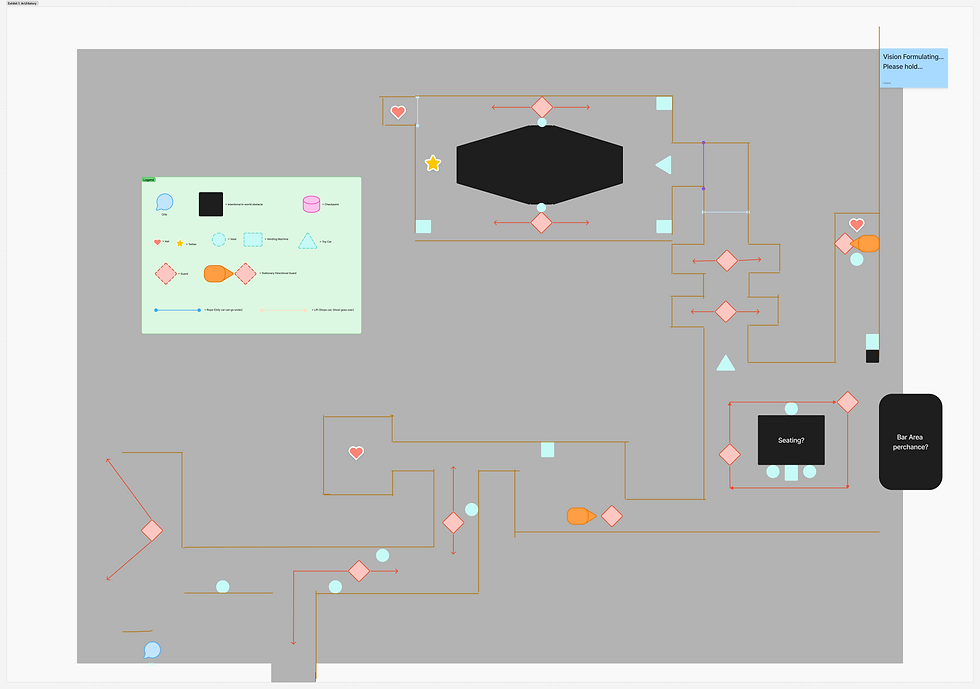
I showed the designers how they could use set pieces to create the spaces needed for their puzzles without taking away from the feeling of a big hosting space in a house. Below is the version of it I showed the designers to use as a reference. Not only did this help maintain the feeling of a house, but it encouraged designers to intentionally plan around set pieces that informed the asset list for the art team.

I maintained a strong vision for the feel of the mansion museum throughout the project. In the final stages of the project I gave feedback to designers as they worked through rounds of iteration on set dressing. Part of our curriculum was to have everyone, including the producers, work in engine and continue to build their skills in Unity. As such, I did the final pass of set dressing in levels 1-3 and level 5. Below is a trailer that focuses on the set dressing of level 1 after it's final pass.
This project taught me that I am a design focused producer. My creative director and I enjoyed working together so much that we are continuing to work together on a new project.